
Canine Gait Patterns:
Canine gait refers to a dog’s ground locomotion – a recurring pattern of limb movement and paw contact that a dog uses to move from one place to another.
A dog’s gait patterns are distinguished primarily by the order and timing of the footfalls, how the limbs coordinate with one another, and the speed that the dog is moving at.
Learning to recognize canine gait patterns can help us describe how a dog is moving more accurately, and may help to support noticing changes from their usual movement.
While researching this blog post, I have not yet found a single resource that brings together all the canine gait patterns covered here. Terminology and classification can also vary among sources, so this lesson draws from multiple references and my personal experience to present these patterns together.
If you’d like a closer look at your own dog’s (or cat’s!) posture and movement, I offer an online Posture & Gait Analysis service that includes a thorough written report with recommended next steps.
Canine Gait: Limb Terminology
In this blog post, the dog’s limbs are abbreviated as:
-
LF: Left Forelimb
-
RF: Right Forelimb
-
LH: Left Hindlimb
-
RH: Right Hindlimb
In the example sequences, → means “followed by,” and + indicates paws touching down together or nearly together.
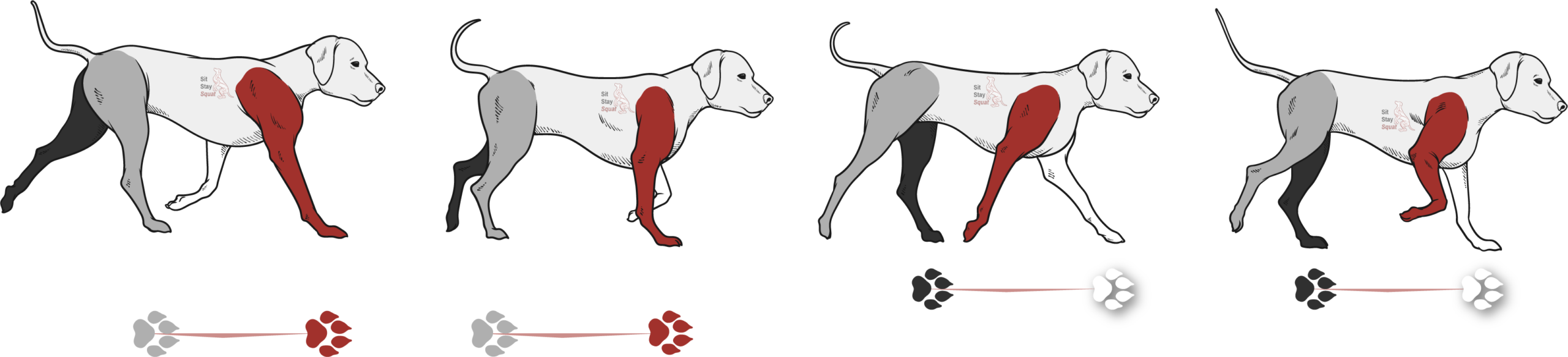
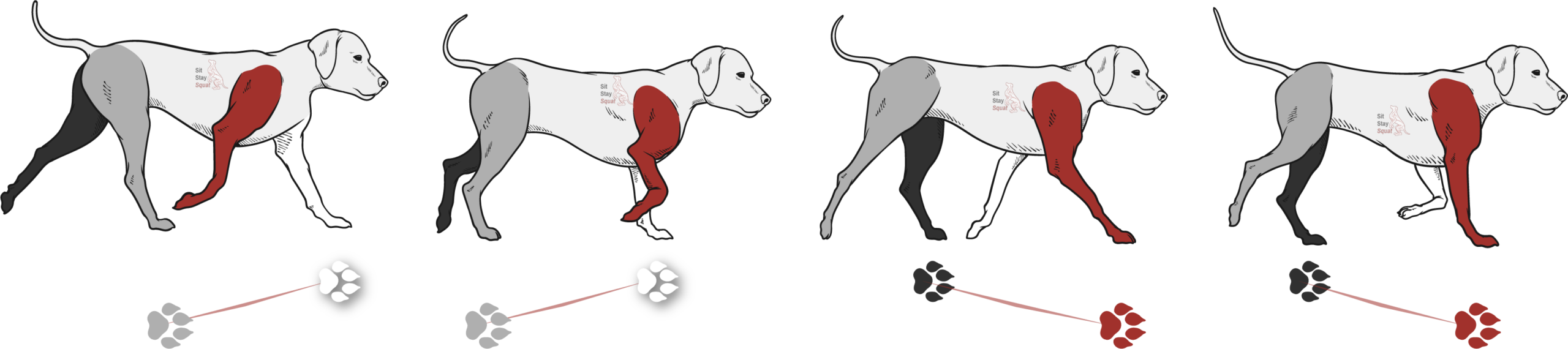
The illustrations show selected moments within a stride. Paws shown supporting the dog together may have touched down at different times.
A set of Key Terms are at the bottom of this blog post, in case any of the canine gait terminology gets confusing!
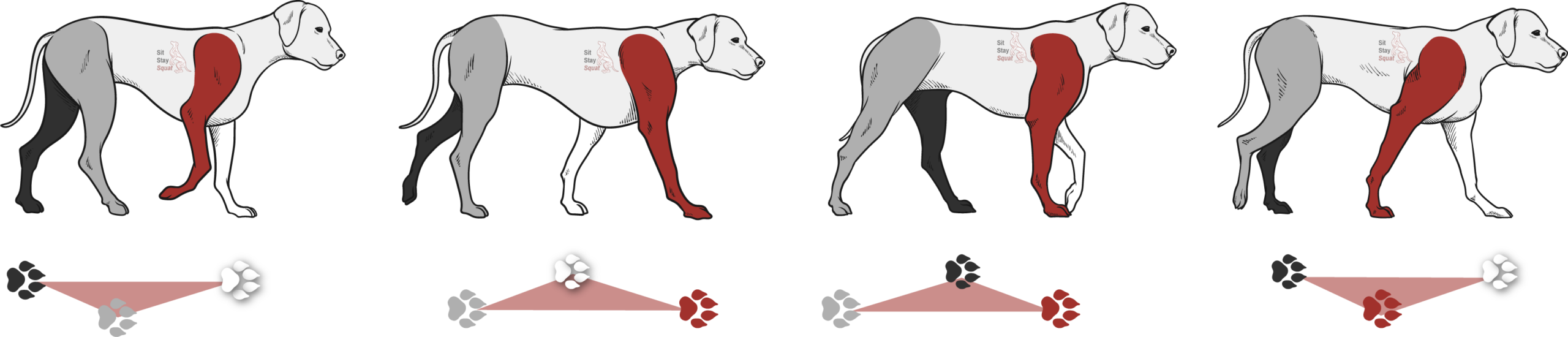
Walk
-
Beats: Four distinct footfalls
-
Limb organization: Symmetrical, lateral-sequence gait
-
Example footfall sequence: RH→ RF → LH→ LF
-
Support: Primarily alternates between two- and three-limb support
-
Suspension: None
-
Leading limbs: None
A walk is generally the slowest canine gait. Each paw touches down separately, and the dog maintains contact with the ground throughout the stride, usually alternating between two- and three-limb support.
“Lateral sequence” means that each hindlimb touchdown is followed by the forelimb on the same side. It does not mean that the same-side limbs land together.
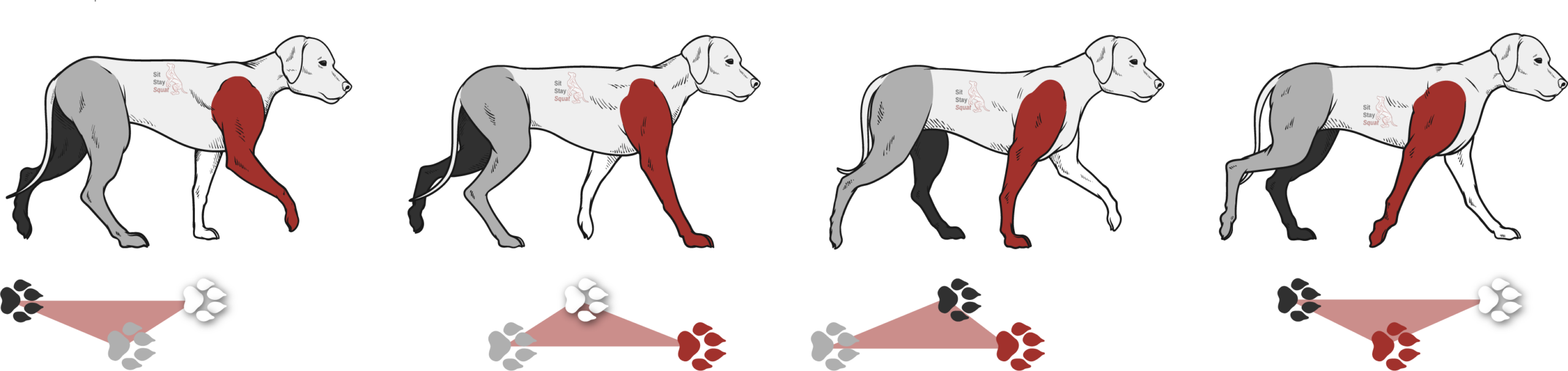
Amble
-
Beats: Four distinguishable footfalls
-
Limb organization: Symmetrical, lateral-sequence gait
-
Example footfall sequence: RH→ RF→ LH→ LF
-
Support: Primarily alternates between two- and three-limb support
-
Suspension: None
-
Leading limbs: None
An amble is often considered a faster walk, where the front leg lifts during the forward swing of the back leg. This appears as if ipsilateral feet are moving together, but the rear limb is moving slightly before the front limb on the same side.
If the rear paw lands before the front paw on the same side, that is an amble – not a pace. Because the touch downs remain distinguishable, an amble is a four-beat gait, unlike the two-beat pace.
Ambling is generally considered an inefficient gait pattern and should typically only be used for short periods, either as a transitional gait between a walk and a trot, or when human interference effects a dog’s speed of movement.
Personal Observations
-
My first senior dog, Missy, often used a very slow amble during walks. She had been diagnosed with intervertebral disc disease (IVDD).
-
My second senior dog, Uno, often transitions to an amble upon fatigue. He has bilateral cranial cruciate ligament (CCL) disease.
It’s possible that an amble was a fast gait for their abilities, but to my eye the overall movement appeared quite slow, and seemed to be a compensatory movement strategy for them.
A gait in and of itself is not a diagnosis, but any changes in a dog’s movement, or movement that appears uncomfortable, is worth a veterinary assessment.
Pace
-
Beats: Two
-
Limb organization: Symmetrical gait using ipsilateral limb pairs
-
Example footfall sequence: RH + RF → LH + LF
-
Support: Alternates primarily between the left and right lateral pairs
-
Suspension: Typically absent, but may appear as speed increases
-
Leading limbs: None
In a true pace, the forelimb and hindlimb on one side move together, followed by the lateral pair on the opposite side.
Because support alternates between the limbs on one side and then the other, the dog’s base of support shifts from side to side, which can produce more visible lateral motion through the trunk.
Pacing can occur as a brief transitional gait, and may happen when a dog is forced to walk at speeds in between a walk and a trot – this can be common when larger dogs are walking on leash at a human-set speed.
Persistent pacing at a speed where the dog would ordinarily be expected to trot may be more significant. A consistent preference for pacing, or difficulty transitioning from a pace into a trot, may indicate that the dog is modifying their movement to accommodate discomfort or another physical limitation.
During trotting, diagonal limb motion creates rotational moments through the trunk. One proposed reason for persistent pacing is that it may reduce some of these rotational demands through the spine – therefore a dog who is experiencing back discomfort may choose to pace rather than trot, in an effort to avoid this rotational torque through their spine.
It’s important to consider the complete context, including whether pacing occurs both on and off leash, whether the dog can transition comfortably into other gaits and whether any additional movement or comfort changes are present.
A new or persistent change in gait, difficulty transitioning into a trot, marked asymmetry, or other signs of discomfort should be discussed with the dog’s veterinary team.
Trot
-
Beats: Two
-
Limb organization: Symmetrical gait using diagonal limb pairs
-
Example footfall sequence: RH + LF → LH + RF
-
Support: Primarily alternating diagonal-pair support
-
Suspension: Absent at a slower trot; see “suspended trot” below
-
Leading limbs: None
A trot is a symmetrical, two-beat gait in which diagonally opposite limbs move as coordinated pairs, for example: the left thoracic limb and right pelvic limb make footfalls together or nearly together, followed by the right thoracic limb and left pelvic limb.
At slower trotting speeds, the stance phases of successive diagonal pairs may overlap briefly, so at least one foot remains on the ground throughout the stride.
Tip: If it’s hard to picture the diagonals, you can think of the limbs on the same side moving in towards the body together, and then apart!

Suspended Trot
-
Beats: Two
-
Limb organization: Symmetrical gait using diagonal limb pairs
-
Example sequence: suspension → LH + RF → suspension → RH + LF
-
Support: Alternating diagonal-pair support separated by aerial periods
-
Suspension: Present
-
Leading limbs: None
A suspended trot is a faster expression of the trot in which the dog becomes airborne between diagonal supports. The diagonal organization remains the same as in a slower trot.
A complete stride may contain two suspension periods, one after each diagonal support. The limbs may also show greater forward “reach” and rearward “drive” excursion than they do during a slower trot.
You may also encounter the terms “flying trot” and “extended trot.” Their usage varies; “suspended” specifically identifies an aerial phase, while “extended” generally refers to increased stride length.

Transverse Canter
-
Beats: Three, with a 1-2-1 rhythm
-
Limb organization: Asymmetrical; the middle beat is formed by a diagonal limb pair (image 3)
-
Left-lead example sequence: RH → LH + RF → LF
-
Support: May include one-, two- and three-limb support as stance phases overlap
-
Suspension: Typically absent at slower speeds; a period of suspension may occur as speed increases
-
Lead relationship: The leading hindlimb and leading forelimb are on the same side
The term “transverse” describes the relationship between the leading hindlimb and trailing forelimb in a diagonal fashion (note paw contact of image 3).
The sequence of limb impact on the ground is 1-2-1:
-
Beat 1: A hindlimb
-
Beat 2: Diagonal hindlimb + forelimb
-
Beat 3: A forelimb
-
sometimes followed by suspension at faster speeds.
The canter is an asymmetrical gait, because limb patterns are different on the right and left sides. In a transverse canter, the leading forelimb is the forelimb that is not part of the diagonal (image 4).
Some sources describe a transverse canter as less common in dogs… but this has not been my personal experience, and I believe that information may have actually derived from horses!
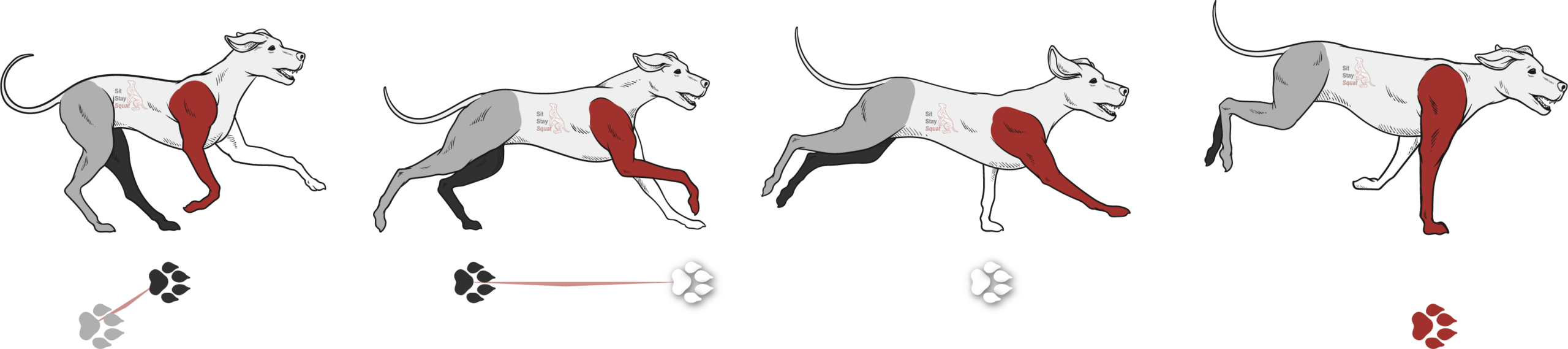
Rotary Canter
-
Beats: Three, with a 1-2-1 rhythm
-
Limb organization: Asymmetrical; the middle beat is formed by a lateral pair (image 2)
-
Right-lead example sequence: RH → LH + LF → RF
-
Support: May include one-, two- and three-limb support as stance phases overlap
-
Suspension: Typically absent at slower speeds; a period of suspension may occur as speed increases
-
Lead relationship: The leading hindlimb and leading forelimb are on opposite sides
The term “rotary” describes how the limbs make contact with the ground in a circular order – either clockwise, or counterclockwise. In a rotary canter, the paired middle beat is lateral (note paw contact of image 2) rather than diagonal.
The sequence of limb impact on the ground is 1-2-1:
-
Beat 1: A hindlimb,
-
Beat 2: Hindlimb + front limb on the same side of the body
-
Beat 3: A forelimb
-
sometimes followed by suspension at faster speeds.
The canter is an asymmetrical gait, because limb patterns are different on the right and left sides. In a rotary canter, the leading forelimb is the forelimb that is not part of the ipsilateral support (image 4).

Transverse Gallop
-
Beats: Four distinct footfalls
-
Limb organization: Asymmetrical; each limb touches down separately
-
Left-lead example: RH → LH → RF → LF → suspension
-
Support: Includes single-limb support and overlapping contacts, which may involve both hind paws, a diagonal pair, or both forepaws.
-
Suspension: Often single suspension (image 6)
-
Lead relationship: The leading hindlimb and leading forelimb are on the same side
Unlike the three-beat transverse canter, the middle diagonal limbs no longer land together. Separating those touchdowns produces the four-beat gallop pattern.
The hindlimbs touch down one after the other, followed by the two forelimbs. The second hindlimb is followed by the diagonally opposite forelimb. For example:
-
Beat 1: Right hind leg lands
-
Beat 2: Left hind leg lands
-
Beat 3: Right foreleg lands
-
Beat 4: Left foreleg lands
Some sources call this a “diagonal gallop” because the second hindlimb is followed by the diagonally opposite forelimb.
A transverse gallop may include a single suspension during collection (image 6).

Rotary Gallop
Double Suspension Rotary Gallop Video
-
Beats: Four distinct footfalls
-
Limb organization: Asymmetrical; contacts progress around the body
-
Right-lead example sequence: RH → LH → suspension → LF → RF → suspension
-
Support: Primarily single-limb support with brief overlapping support possible
-
Suspension: Can include double suspension (image 3 & 6)
-
Lead relationship: The leading hindlimb and leading forelimb are on opposite sides
The rotary gallop is typically considered the fastest, yet most fatiguing of all the canine gait patterns. What primarily makes a gallop rotary is the footfall sequence – with the limbs touching down in a circular pattern.
The double-suspension gallop that sighthounds are known for is a rotary gallop, but not every dog produces two moments of suspension during a rotary gallop.
When a rotary gallop includes two periods of suspension, they are described as:
-
Extended suspension: The forelimbs reach forward while the hindlimbs extend rearward (image 3)
-
Gathered suspension: Sometimes called collection or flexion suspension – the limbs are drawn beneath the body (image 6)
Fun Fact: A Greyhound can reach speeds of up to 72km/hr! (45mph)
Canine Gait: Key Terms
Asymmetrical gait: A gait in which the limb movements on one side of the body do not mirror the movements on the opposite side.
Base of support: The contact area created by the paws currently on the ground. One paw creates a single contact area, two paws create a line of support, and three or four paws create a larger base of support area.
Beat: A distinct touchdown moment within a gait cycle – think as if the dog is moving across a drum, and how many “beats” you would hear. Two paws landing together produce one beat. Suspension does not count as a beat.
Footfall: The placement of a paw on the ground.
Footfall sequence: The repeating order in which the paws touch the ground.
Gait transition: A change from one gait pattern to another.
Leading limb: In an asymmetrical gait, the limb that touches down second within the forelimb or hindlimb pair and is placed farther forward. The forelimbs and hindlimbs can have the same lead or opposite leads.
Limb sequence: The order in which the feet contact the ground during one complete stride.
Touchdown: The moment a paw makes contact with the ground.
Speed: Distance travelled per unit of time. Dogs can increase speed by increasing stride length, stride frequency or both.
Stance phase: The portion of an individual limb’s gait cycle during which the paw is in contact with the ground. It begins at initial contact (when the paw touches the ground) and ends at toe-off (when the paw leaves the ground).
For observational purposes, the stance phase can be described in three broad parts:
-
Initial stance: The paw makes contact with the ground, and the limb begins to accept load.
-
Mid-stance: The middle portion of ground contact, as the body progresses over the planted paw.
-
Terminal stance: The limb is caudal relative to the trunk as the foot approaches toe-off. The paw then leaves the ground to begin the swing phase.
Stride length: The distance travelled during one complete stride, measured between successive ground contacts of the same foot.
Support phase: A period defined by the number and arrangement of paws touching the ground. Support may be:
-
Unipedal: one paw grounded
-
Bipedal: two paws grounded
-
Tripedal: three paws grounded
-
Quadrupedal: all four paws grounded
A stance phase describes one limb. A support phase describes the dog’s whole-body contact pattern.
Suspension or flight phase: A period when all four paws are off the ground.
Swing phase: The portion of an individual limb’s gait cycle during which the paw is off the ground. It begins at toe-off and ends at the next initial contact of that same paw.
For observational purposes, the swing phase can be described in three broad parts:
-
Initial swing: The paw has just left the ground and begins moving forwards from a relatively caudal position.
-
Mid-swing: The paw continues travelling forwards beneath the body.
-
Terminal swing: The limb completes its forward swing and positions the paw for landing. This phase ends at initial contact, beginning the next stance phase.
Symmetrical gait: A gait in which the limbs on the left and right sides follow the same timing pattern. Walk, amble, pace, and trot are commonly classified as symmetrical gaits.
Trailing limb: The limb that touches down first within the forelimb or hindlimb pair.